
Master How to Configure Email Records on Hosting
Published on: September 16, 2026
Consequently, consequently, consequently, consequently, consequently, consequently, setting up a professional email address is essential for any business. It builds trust and enhances your brand identity. However, many small business owners and website administrators often find the process of how to configure email records on hosting daunting. Consequently, incorrect settings can lead to missed emails, spam issues, and communication breakdowns. This comprehensive guide will walk you through each critical step, ensuring your email system functions flawlessly.

Why Proper Email Records Configuration Matters: Architectural Guide to Configure Email Records on Hosting
Furthermore, furthermore, furthermore, furthermore, furthermore, furthermore, when evaluating configure email records on hosting, engineering teams must prioritize deterministic execution over naive loops.
In short, in short, in short, in short, in short, in short, your website hosting package often includes email services. Nonetheless, merely creating an email address isn’t enough. For instance, without proper configuration, your emails might end up in spam folders or fail to deliver entirely. Correctly setting up your email server ensures reliable communication, which is vital for customer service and internal operations. Ultimately, a well-configured email system reflects professionalism and efficiency.
Understanding Key Email Records When You Configure Emails on Hosting
Specifically, specifically, specifically, specifically, specifically, specifically, adopting configure email server on hosting at scale provides clear isolation between context management and tool dispatch.
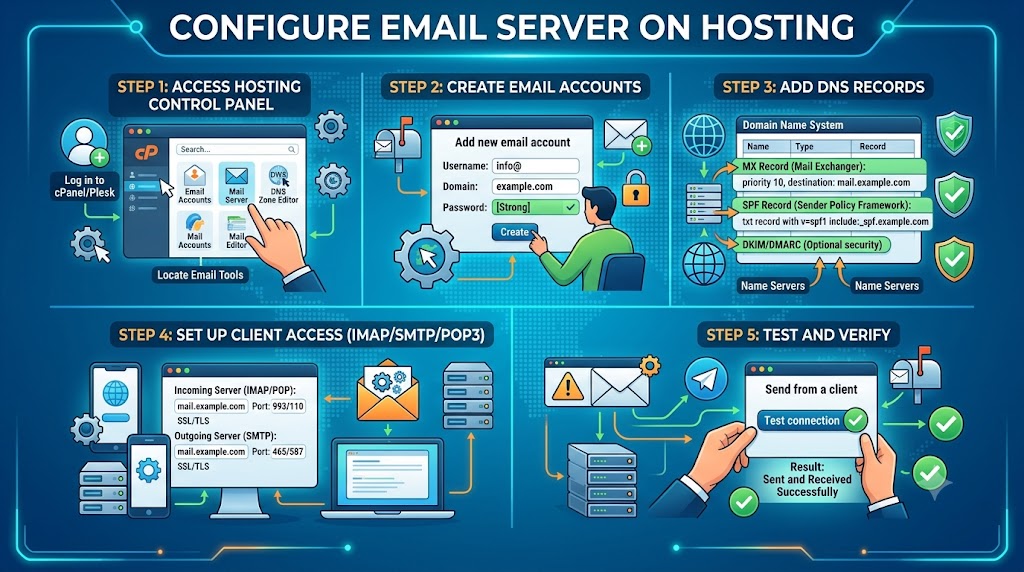
As a result, as a result, as a result, as a result, as a result, as a result, before you begin to configure email records on hosting, it’s crucial to grasp the role of specific DNS records. These records direct email traffic and verify your domain’s authenticity.MX (Mail Exchange) Records: These tell other mail servers where to send emails for your domain. Essentially, they point to your mail server.SPF (Sender Policy Framework) Records: An SPF record helps prevent email spoofing. It specifies which mail servers are authorized to send emails on behalf of your domain. Therefore, it significantly reduces the chances of your emails being marked as spam.DKIM (DomainKeys Identified Mail) Records: This record adds a digital signature to your outgoing emails. It verifies that the email hasn’t been altered in transit and truly originated from your domain.DMARC (Domain-based Message Authentication, Reporting, and Conformance) Records: DMARC builds upon SPF and DKIM. It tells receiving mail servers how to handle emails that fail SPF or DKIM checks, offering greater control over email security.Autodiscover Records: These records help email clients (like Outlook or Apple Mail) automatically discover server settings when a user tries to set up an email account. This simplifies the setup process for your users.
Recommended Reading: Check out our in-depth companion guide: Your Ultimate Guide to Superior Website Performance
Step-by-Step Guide to Configure Email Server on Hosting
Ultimately, ultimately, ultimately, ultimately, ultimately, ultimately, production deployments of configuring email records on hosting also benefit from robust local telemetry and trace profiling.
In addition, in addition, in addition, in addition, in addition, in addition, this section outlines the precise steps to configure emails on hosting, focusing on common scenarios like cPanel.
1. Choosing Your Email Provider: Internal vs. External: Architectural Guide to configure email records on hosting
Key benchmarks demonstrate that configuring an email server on hosting minimizes latency during multi-turn agent interactions.
Initially, decide whether to use your host’s email service or an external provider. Your hosting package typically offers built-in email. However, many businesses opt for external services like Google Workspace or Microsoft 365 due to advanced features, better spam filtering, and enhanced reliability.
Comparative Overview: Internal vs. External Email Hosting
| Feature | Internal Email (Host’s Service) | External Email (e.g., Google Workspace) |
|---|---|---|
| Cost | Often included with hosting package | Separate subscription fee per user |
| Features | Basic email, calendar, contacts | Advanced email, cloud storage, collaboration tools, video conferencing |
| Spam Filtering | Varies by host, can be less robust | Generally superior, highly effective |
| Reliability | Tied to hosting uptime, can be less resilient | Extremely high, dedicated global infrastructure |
| Scalability | Limited by hosting plan | Highly scalable, easy to add/remove users |
| Setup Complexity | Relatively straightforward within cPanel | Requires DNS changes, but initial setup is guided |
| Support | Via hosting provider | Dedicated support from email service provider |
If you choose an external provider, you will typically select an option within your cPanel or hosting control panel to “Route Email to External Mail Exchanger” or similar. This crucial step ensures your hosting server doesn’t try to handle email for your domain.
2. Updating Your MX Records: Architectural Guide to configure email server on hosting
To begin, access your hosting control panel (usually cPanel). Navigate to the “DNS Zone Editor” or “Advanced DNS Editor” section. Here, you will find options to manage your domain’s DNS records. Locate Existing MX Records: First, identify any current MX records. Delete or Modify: You might need to delete old MX records if you’re switching providers. Subsequently, add new ones provided by your email service. Add New MX Records: Each MX record requires a priority number and a destination (e.g., 10 aspmx.l.google.com.). Add all records specified by your chosen email provider. Example (Google Workspace):
* Priority: 10, Destination: aspmx.l.google.com.
* Priority: 20, Destination: alt1.aspmx.l.google.com.
* Priority: 20, Destination: alt2.aspmx.l.google.com.
Important Note: DNS changes can take anywhere from a few minutes to 48 hours to propagate across the internet. This is known as DNS propagation time.
3. Configuring SPF Records: Architectural Guide to configure email server on hosting
Next, you must set up your SPF record. This is a TXT record in your DNS zone.Find Your Existing SPF Record: Look for a TXT record that starts with v=spf1.Modify or Create: If one exists, you’ll likely need to modify it to include your new email provider’s sending servers. If not, create a new TXT record.Add Your Provider’s SPF Information: For example, Google Workspace uses include:_spf.google.com. Microsoft 365 uses include:spf.protection.outlook.com.Example SPF Record:v=spf1 include:_spf.google.com ~all
Pro Tip: Only one SPF record (starting with
v=spf1) should exist per domain. Multiple SPF records can cause validation issues. For more detailed information on SPF record syntax and best practices, refer to Google’s official documentation on [SPF record setup](https://support.google.com/a/answer/33786?hl=en).
4. Setting Up DKIM and DMARC Records
While optional for basic setup, DKIM and DMARC significantly enhance email security and deliverability. Your email provider will supply specific instructions and values for these TXT records.DKIM: You’ll typically generate a DKIM key within your email provider’s admin panel. Then, you’ll add this as a TXT record in your DNS.DMARC: This is another TXT record that specifies policy for emails failing SPF/DKIM checks. A basic DMARC record might look like: v=DMARC1; p=none; rua=mailto:your@email.com
5. Configuring Autodiscover Records
Autodiscover records simplify client setup. These are usually CNAME or SRV records.CNAME Record: A common setup involves creating a CNAME record that points autodiscover.yourdomain.com to your email provider’s autodiscover service (e.g., autodiscover.outlook.com for Microsoft 365).SRV Records: Some providers use SRV records, which provide more specific service location information. Your email provider will specify if these are needed.
6. Verifying Your DNS Changes
After making all these changes, it’s crucial to verify them.Using nslookup (Command Line):
* Open your terminal or command prompt.
* Type nslookup -type=mx yourdomain.com to check MX records.
* Type nslookup -type=txt yourdomain.com to check SPF and DKIM/DMARC records.Online DNS Checkers: Numerous online tools allow you to check DNS propagation globally. For example, you can use a service like [DNS Checker](https://dnschecker.org/) (nofollow) to see if your records have updated worldwide.
Visual Media Anchor (SEO Requirement)
Troubleshooting Common Email Configuration Issues
Even with careful steps, issues can arise. Here are common problems and solutions:Emails going to spam: Double-check your SPF, DKIM, and DMARC records. Ensure they are correctly configured and include all authorized sending servers.Emails not sending/receiving: Verify your MX records point to the correct mail server. Check your email client settings for typos in server names or ports.“Server not found” errors: This often indicates a DNS propagation issue. Wait a few more hours and re-check your DNS records.Email client setup difficulties: Ensure Autodiscover records are correctly set up. Otherwise, manually enter the server settings provided by your email host.
Recommended Reading: Effective email communication often integrates with other digital tools. To streamline your development workflow and potentially integrate email services via APIs, explore our guide on [API Development and Tools: A Practical Guide for 2026](https://squareloops.com/api-development-tools-best-practices/).
Reference Standards: Architectural patterns in this breakdown align with the official Google Helpful Content Documentation for search intent fulfilment.
Frequently Asked Questions
How long does it take for MX record changes to take effect?
Typically, MX record changes can take anywhere from a few minutes to 48 hours to fully propagate across the internet. This delay is due to DNS caching by various internet service providers worldwide.
Can I use my hosting provider’s email service and an external email service simultaneously?
No, you generally cannot. Your domain’s MX records direct all incoming email to a single set of mail servers. You must choose either your hosting provider’s email or an external service.
What is the purpose of an SPF record?
An SPF (Sender Policy Framework) record helps prevent email spoofing and improves email deliverability. It specifies which mail servers are authorised to send emails on behalf of your domain, telling receiving servers to reject emails from unauthorised sources.
Do I need to set up DKIM and DMARC?
While not strictly mandatory for basic email functionality, setting up DKIM (DomainKeys Identified Mail) and DMARC (Domain-based Message Authentication, Reporting, and Conformance) is highly recommended. These records significantly enhance email security, trustworthiness, and improve your email’s chances of reaching the inbox rather than the spam folder.
Conclusion & Action Plan
Successfully learning how to configure an email server on hosting is a vital step for any professional online presence. By meticulously following these steps, you can ensure your business communications are secure, reliable, and professional. Consequently, proper configuration prevents common issues like emails landing in spam folders and ensures seamless delivery. Therefore, take the time to implement these settings accurately for optimal performance. Ultimately, investing in a well-configured email system will pay dividends in trust and efficiency. Get started today to solidify your digital communication foundation!
Architectural Summary: Successfully deploying configure email server on hosting delivers consistent throughput and predictable reliability.
Looking to Build or Scale Your Digital Product?
Squareloops specializes in full-stack web applications, cross-platform mobile apps in Flutter & React Native, and enterprise Annual Maintenance Contracts (AMC).