
API Development and Tools: A Practical Guide for 2026
Published on: August 12, 2026
APIs are the language of modern software. When designed right, they enable systems to communicate seamlessly, accelerate development, and reduce support overhead. For businesses, a well-crafted API strategy translates directly to faster time-to-market and better developer experiences. Consequently, mastering API development tools and best practices has become essential for engineering teams. Furthermore, following a structured, design-first approach helps organisations build scalable, maintainable APIs that developers actually want to use.
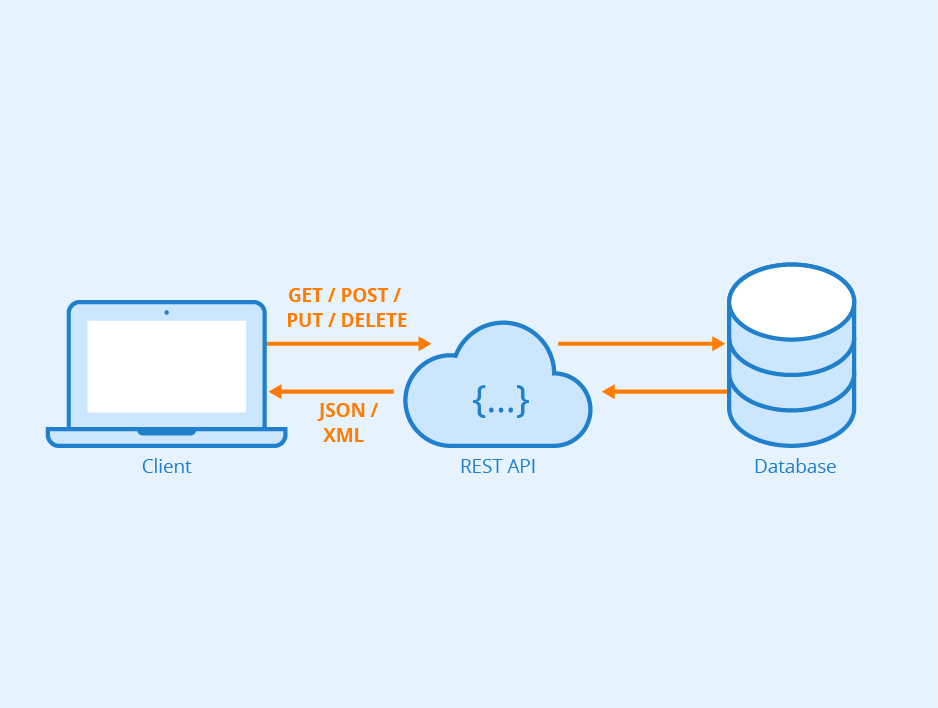
Before diving into the tools and strategies, let us clarify what an API actually is. API stands for Application Programming Interface. In simple terms, it is a set of rules that allows different software applications to talk to one another. Think of it as a waiter in a restaurant: you (the user) place an order with the waiter (the API), who then takes that request to the kitchen (the server) and brings back your meal (the response). Consequently, APIs power nearly every digital interaction you experience—from logging into a website with your Google account to checking the weather on your phone. Furthermore, they enable developers to build new features without reinventing the wheel by securely connecting to existing services and data sources.
Design-First vs. Code-First: Choosing the Right Approach
Understanding the fundamental difference between these methodologies is your starting point for API development. Design-first centres the API at the beginning of the project, while code-first prioritises building the application first and the API later
| Aspect | Code-First | API-First |
|---|---|---|
| Focus | Implementation and business logic first | API contract is the starting point |
| Speed | Faster initial start | Slower start but faster iteration |
| Workflow | Frontend dependent on backend progress | Parallel development based on contract |
| Scalability | Changes often require greater adjustments | Growth accounted for via versioning |
| Documentation | Often an afterthought | Accurate because it’s the source of truth |
API-first often takes a design-first form, where the API contract comes before any implementation. This usually results in better parallel development and consistency, but only if done well.
The API Development Lifecycle: From Design to Production
A robust API development workflow follows several key stages, each supported by specialised tools
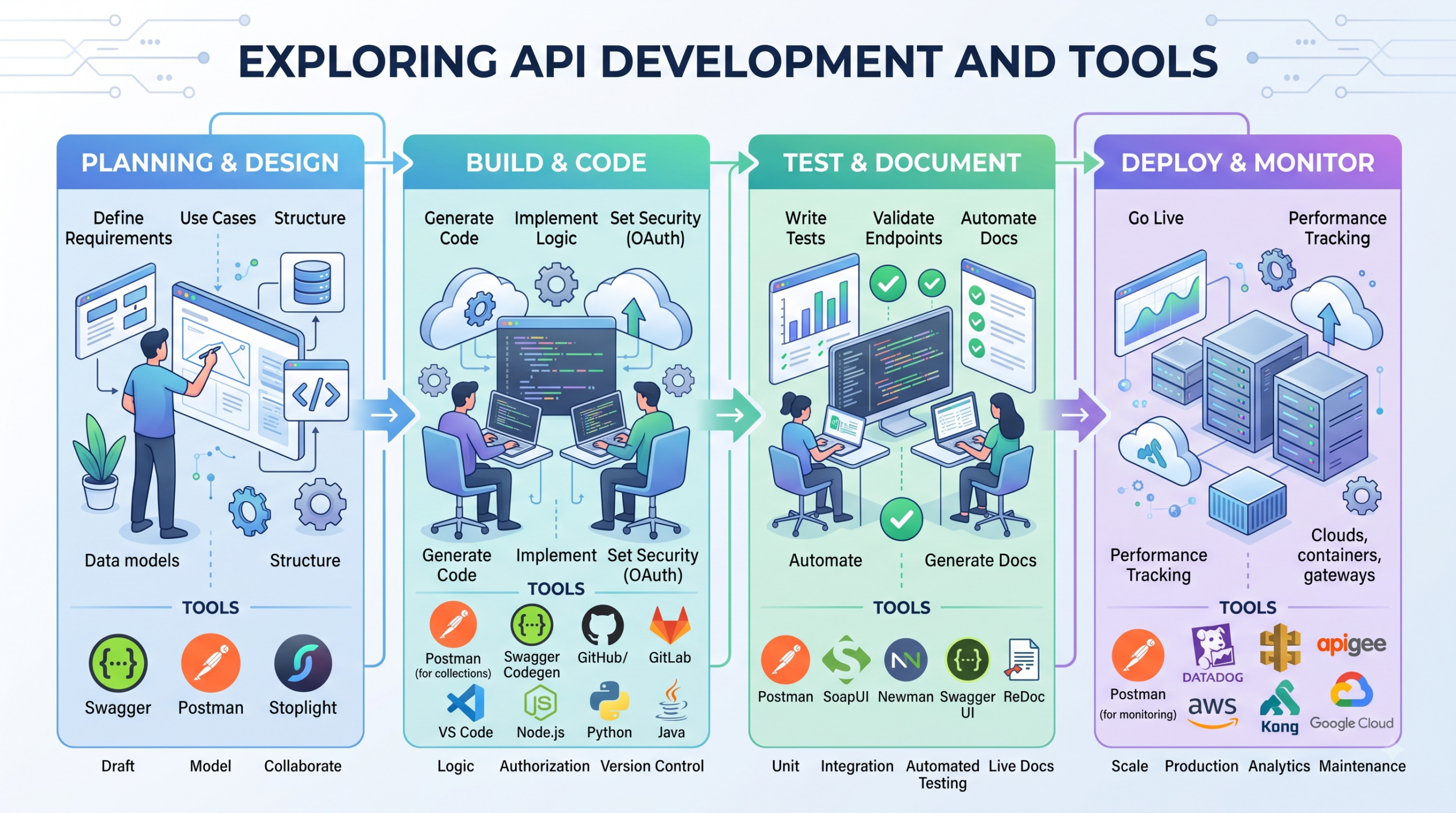
1. Contract Design and Authoring
This is where you create the actual API specification. The industry standard is OpenAPI (formerly Swagger), a language-agnostic, machine-readable format for describing RESTful APIs.
Tool Recommendations for This Stage:
- Stoplight Studio: Best for teams that prefer a visual, UI-driven approach over writing YAML. Excellent visual editor with real-time validation.
- Swagger Editor: Ideal for developers comfortable with YAML/JSON who want maximum control. Provides real-time validation and shows a live preview of your documentation.
- Apidog’s Visual Editor: A form-based interface where each endpoint is a structured form with path, method, parameters, and responses. You don’t have to write YAML unless you want to. Changes sync between visual and raw views automatically.
2. Mocking and Early Integration
Once you have a contract, you can generate a mock server that simulates the API’s behaviour. This is where design-first development pays immediate dividends.
Key Tools:
Prism (by Stoplight): A dedicated mock server that uses your OpenAPI spec to generate realistic responses, including status codes and example data.
Apidog’s Smart Mock: Generates mocks instantly with intelligent data—email fields return valid email addresses, integers respect min/max ranges, and enums return randomly selected values.
WireMock: Extremely flexible and programmable. Simulate delays, faults, and complex response scenarios. Great for testing edge cases.
3. Documentation Generation
Never write API documentation by hand again. Generate beautiful, interactive docs directly from your contract .
Popular Options:
- Swagger UI: Provides the familiar, interactive “Try it out” interface.
- ReDoc: Offers clean, readable documentation focused on developer experience.
- Postman Collections: Serve as executable documentation, letting users explore endpoints through predefined request flows.
4. Implementation and Debugging
Write the API logic, connect with development databases, and test with both automated and manual tools. Environment management is critical here—sandboxes provide isolated “playgrounds” for testing without affecting production.
Popular Frameworks by Language :
- Node.js: Express.js (minimalist) or Fastify (high-performance)
- Python: Flask (lightweight) or Django REST Framework (enterprise-ready)
- Java: Spring Boot (comprehensive enterprise framework)
- Go: Gin or Echo (high-concurrency workloads)
5. Testing and Validation
Rigorous testing ensures your API meets its contract and handles edge cases gracefully.
Testing Tools:
- Schemathesis: Property-based testing that reads your OpenAPI schema and automatically generates test cases—including edge cases you’d never think to write.
- Hurl: Runs HTTP requests written in plain text and asserts on responses. Great for contract-style checks in CI pipelines .
- REST Assured: A Java DSL that makes REST API assertions readable and integrates with JUnit/TestNG.
6. Monitoring and Observability
Continuously track API uptime, error rates, and performance using platforms like Datadog, New Relic, or custom Prometheus setups.
RESTful API Best Practices for 2026
Following these proven practices ensures your API is robust and developer-friendly.
Use JSON for Request and Response Payloads
JSON has won. It’s lightweight, human-readable, and natively supported in every language. Always include Content-Type: application/json to tell caches, firewalls, and clients how to interpret the payload.
JSON Tips That Actually Matter :
- Pick a naming convention (
camelCaseorsnake_case) and stick to it - Use
nullfor absent values—don’t omit keys or use empty strings - Validate schemas and reject malformed requests early
- Return
400 Bad Requestwith a clear message for invalid JSON
Implement Comprehensive Error Handling
How your API handles failures says a lot about its overall quality. Vague errors waste developer time .
What a Good Error Response Includes :
- Consistent JSON structure across all endpoints
- Machine-readable error codes like
invalid_api_key - Human-readable messages aimed at developers
- Contextual details (which field failed, when rate limits reset)
- A unique request ID for log correlation
Example Error Response:
{
  "error": {
    "type": "invalid_request_error",
    "message": "Invalid JSON format: Unexpected token } in JSON at position 54"
  }
}
Implement an API Versioning Strategy
APIs evolve. Without versioning, a single deployment can break every client integration.
- URL path versioning:
https://api.example.com/v1/users(simple, explicit) - Header versioning: Version goes in a request header (cleaner URLs, less visible)
- Query parameter versioning:
https://api.example.com/users?version=1(clutters URLs)
Best Practice: Only introduce a new major version for breaking changes. Adding optional fields or fixing bugs generally doesn’t require a new version.
Secure Your API Properly
Security is non-negotiable. Never send credentials over plain HTTP—always enforce HTTPS.
- Use short-lived access tokens (15-60 minutes)
- Implement refresh tokens for extended sessions
- Define granular permissions via scopes and roles
- Implement token revocation through logout endpoints
Building a Design-First Workflow with Apidog
Apidog’s architecture is built around the spec as the primary artefact. The design tab, mock server, test runner, and documentation are all connected to the same underlying API definition.
Key Features:
- Visual OpenAPI Editor: Form-based editing with real-time validation
- Smart Mock: Instant mock generation from schemas
- Team Review Workflow: Comment on endpoints, track changes, and maintain history
- Documentation Preview: Share documentation links with stakeholders during the design phase
Conclusion
In short, successful API development requires a structured approach, the right toolset, and adherence to proven best practices. Ultimately, adopting a design-first workflow enables parallel development, accurate documentation, and faster iteration cycles. As a result, teams ship better software with fewer integration surprises. Furthermore, tools like OpenAPI, Swagger UI, ReDoc, and Apidog streamline the entire lifecycle from design to deployment.
By shifting to an API-first mindset, you reduce friction between frontend and backend teams, improve developer experience, and build more scalable systems. Consider implementing contract-first practices with OpenAPI, leveraging automated testing with tools like Hurl or Schemathesis, and maintaining clear versioning strategies for long-term success. For deeper learning, explore Postman’s API documentation guide or the OpenAPI Initiative’s official specification.
Looking to Build or Scale Your Digital Product?
Squareloops specializes in full-stack web applications, cross-platform mobile apps in Flutter & React Native, and enterprise Annual Maintenance Contracts (AMC).